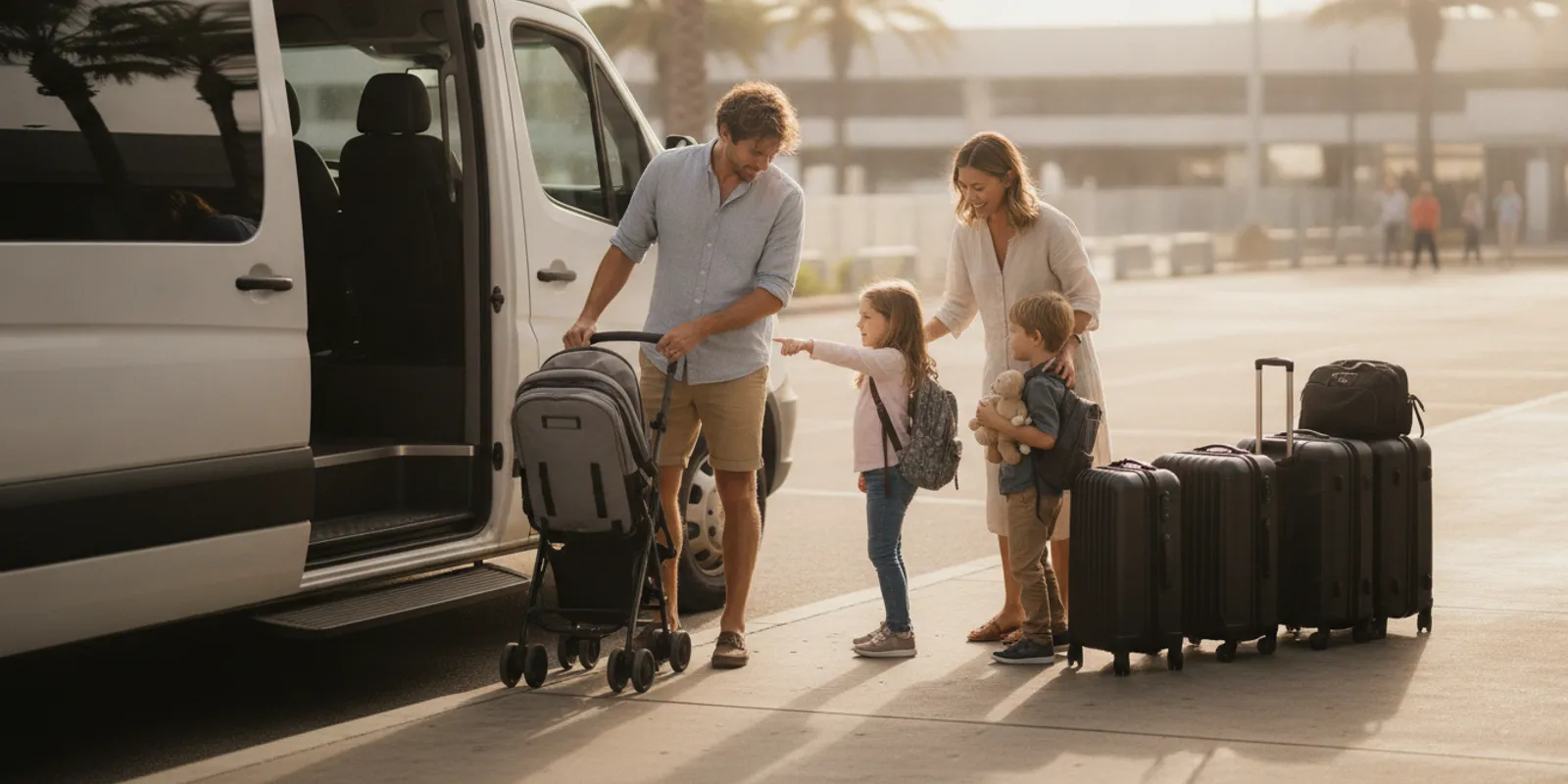
Planning an LAX airport transfer with stroller and luggage starts with more than counting travelers. A stroller takes up cargo space, bags vary in size, and a vehicle that fits everyone in the seats may still leave little room for belongings. A few checks before booking can help your family travel together without last-minute reshuffling.
What should you count before choosing a vehicle?
Start with the full group, then list every item that needs to travel in the vehicle. Include adults and children, carry-ons, checked bags, a stroller, and any other bulky item. Do not count a child as a bag or assume that a folded stroller takes no meaningful space. Its frame and wheels can use cargo room even when folded.
- Count each passenger who needs a seat.
- Count suitcases individually and note whether they are large checked bags or small carry-ons.
- Record the stroller type and whether it folds compactly.
- Add other bulky items, such as a portable crib, only if you will bring them.
- Allow room for items you may acquire before the return trip.
These details give you a useful starting point for comparing vehicle options. If you are unsure how your bags may fit, review PickUpRide’s guide to luggage and SUV space and its overview of airport vehicles for luggage.
How do passenger seats and cargo capacity work together?
Passenger capacity and luggage capacity are separate planning questions. A vehicle may have enough seats for the family but not enough practical room for every suitcase and a stroller. Conversely, a roomy cargo area does not help if the passenger count exceeds the available seats. Check both figures, and describe the actual load when you request a quote.
PickUpRide lists several vehicle configurations. Its published figures give a useful comparison, but they are not a guarantee that a particular combination of stroller and bags will fit. Dimensions and shapes vary, so confirm your specific items before finalizing the ride.
| Vehicle option | Published passenger capacity | Published bag capacity | Planning note |
|---|---|---|---|
| Express | 5 | 7 | Check whether a stroller uses room needed for bags. |
| Premium | 6 | 6 | Compare the complete bag count alongside the stroller. |
| Exclusive 13 | 9 | 13 | Compare your full group and luggage list with the listed capacities. |
| Exclusive 16 | 9 | 16 | Ask how a stroller affects space for your specific bags. |
| Exclusive 1012 | 10 | 12 | Useful to compare when passenger and bag counts differ. |
| Sprinter Corporate Coach | 12–14 | 10 | Confirm the passenger configuration and luggage needs. |
For additional context on the vehicle lineup, see the PickUpRide fleet page. If your family includes several children or multiple adults, the large-group van planning guide can help you think through passenger capacity. Choose based on the real combination of people and belongings, not the largest number shown in a vehicle name.
How should you describe a stroller and bags when booking?
Give the provider a clear, concise inventory. For example: “Four passengers, three checked suitcases, two carry-ons, and one compact folding stroller.” If the stroller is oversized, has a detachable bassinet, or does not fold, mention that. If you are uncertain about its size, give a brief description rather than relying on the word “stroller” alone.
Also explain whether the group needs to remain in one vehicle. PickUpRide provides private point-to-point transportation; its private versus shared shuttle explainer describes the distinction. You can also review the company’s airport transportation services before requesting a trip.
When making a booking request, provide the pickup and destination, travel date and approximate time, passenger count, and item list if convenient. These details help the provider assess an appropriate vehicle and prepare a quote. Check that your confirmation reflects the requested group and luggage information.
What should you check before the travel day?
- Confirm the vehicle. Make sure the listed passenger and bag capacities suit your full inventory, including the stroller.
- Confirm pickup instructions. Review the meeting plan and how you will communicate after landing. PickUpRide’s airport pickup guide explains details travelers may need to coordinate.
- Keep essentials close. Put documents, snacks, and items you may need during the trip in a manageable carry-on, while remembering that carry-ons still take space.
- Plan for the return journey. If you may have extra bags after your stay, include that possibility when checking capacity.
- Review your booking details. Use the frequently asked questions and contact information if you need to clarify a detail.
Families with an infant or young child should confirm any child-seat request directly during booking. Do not assume a seat or particular setup will be included unless it has been confirmed for your reservation.
Which transportation option fits a family with a stroller?
The right choice depends on the group’s priorities, luggage, and whether keeping everyone together matters. A rideshare may require more than one car if the group and cargo do not fit together, while public transit can involve managing bags and a stroller through transfers and stations. A pre-booked private vehicle offers a single point-to-point arrangement, but the family should still verify that the selected vehicle fits its actual load.
Compare options using these questions:
- Can every traveler ride in the same vehicle?
- Is there enough room for the stroller as well as the bags?
- Do you know the pickup arrangement and expected quote before confirming?
- Will the plan be manageable for the adults handling children and luggage?
For a broader view, compare PickUpRide’s private shuttle and rideshare considerations. The goal is to match the transport plan to your family’s complete passenger and cargo list.
How can you make the luggage plan more reliable?
Think through the load as a physical arrangement, not only a count. Two large hard-shell suitcases can occupy space differently from several soft-sided bags. A stroller may fold flat, or it may remain bulky because of its frame, wheels, or attached accessories. This is why published bag capacity is a starting reference rather than a promise that every mix will fit identically.
Before requesting a quote, you can make a short list with three columns: traveler, bag, and special item. Mark which bags are checked-size and which are carry-ons. Note whether the stroller folds and whether any part detaches. If a bag is unusually large or the stroller is a full-size jogging model, mention it. These practical details can help avoid choosing based only on an approximate bag count.
It can also help to keep the list consistent for the trip back. Families sometimes have an extra shopping bag, souvenirs, or a different mix of items on the return. If the return load could be larger, mention the possibility when discussing vehicle fit instead of assuming the outbound arrangement will cover it.
What should you do if the first vehicle option seems tight?
If the listed passenger and luggage figures leave little margin, do not rely on squeezing items into the available space. Ask about another configuration and describe the stroller and bags accurately. Depending on the group, choosing more cargo room may matter more than choosing the option with the highest seat count. Conversely, a larger passenger configuration is not automatically the best fit if its listed bag capacity is lower.
Use a simple decision sequence: confirm that every traveler has a seat, compare the bag count with the listed capacity, then ask how the stroller affects the specific load. If the provider cannot confirm that the complete set will fit, discuss alternatives before completing the reservation. This is more useful than discovering the mismatch at pickup, when children, luggage, and travel timing can make a change harder to manage.
For travel with a group that might need separate vehicles, weigh the practical cost and coordination of splitting up against a configuration that may keep everyone together. If one vehicle is important, state that preference early. A clear request makes it easier to compare feasible options without treating capacity figures as interchangeable.
What does a realistic packing example look like?
Consider a family of four traveling with three checked bags, two carry-ons, and a folding stroller. The passenger count is straightforward, but the cargo count needs a closer look: five bags plus one bulky item. Compare the family against both seat and bag capacity, then explain that the stroller is additional cargo rather than assuming it is included in a bag count.
Now consider a family with two adults, three children, four checked cases, and a full-size stroller. A vehicle with enough seats may still be a poor match if the cases and stroller compete for the same cargo space. In this case, describe the stroller dimensions or model in general terms, mention whether its wheels detach, and ask the provider to check the load against the selected vehicle. If the group is flexible about bags, reducing or consolidating luggage may also make the plan simpler.
These examples do not identify a guaranteed vehicle. They show why the same passenger number can lead to different vehicle choices: one family may travel with compact soft bags, while another brings rigid cases and a wide stroller. State the actual inventory so the comparison reflects your trip rather than an average passenger.
How can you prepare for the pickup itself?
Once the vehicle and load are confirmed, make the arrival plan simple to follow. Keep the booking details accessible on a phone or in a travel folder, and make sure the adult coordinating the pickup can find the instructions quickly. If family members are dividing tasks, agree in advance who will handle the stroller, who will watch the bags, and who will communicate with the driver.
At the airport, keep the stroller folded only when it is practical and safe to do so; avoid putting loose small items where they can fall out during handling. Before the vehicle departs, do a brief count of travelers and bags. A quick checklist—people, suitcases, carry-ons, stroller, essentials—can catch a forgotten item without slowing the whole group.
For a clearer picture of pickup coordination, review the airport pickup process. If any instruction is unclear, ask before travel day rather than trying to resolve it while managing children and luggage curbside.
Frequently asked questions
Should I count a stroller as luggage?
Yes. Include it in the item list because it occupies cargo space, even when folded. A compact stroller and a bulky stroller can affect available room differently.
Is passenger capacity enough to tell whether a vehicle will fit?
No. Passenger capacity tells you how many seats are listed, not whether all your bags and stroller will fit as well. Check passenger and bag figures, then confirm your particular items.
What if my family’s bags exceed the listed capacity?
Do not assume the vehicle can accommodate them. Share the passenger and item counts when requesting a quote and ask which configuration is appropriate. Discuss whether changing the vehicle or travel plan is possible before booking.
What is the most useful detail to provide about a stroller?
Say whether it folds and whether it is compact or bulky. Mention a detachable bassinet or other large component, too. A short description helps distinguish a compact folded stroller from a larger setup.
With a complete passenger count, a realistic list of bags, and a clear stroller description, your family can compare vehicle options before travel day and confirm a plan that keeps the group and its belongings together.
For general guidance on using child restraints, see the National Highway Traffic Safety Administration’s child passenger safety guidance, which supports comparing transport arrangements before traveling.