Getting children from LAX to Disneyland, Anaheim, or another Southern California destination takes more planning than choosing the quickest ride in an app. Families need the right restraint, enough room for luggage, and a pickup plan that still works when everyone is tired and navigating an unfamiliar terminal.
Request a quote or reserve your private LAX ride
The best lax airport shuttle with child car seats is a pre-booked private transfer where you share each child’s age and size. Request the correct seat type and quantity, and confirm availability before travel. PickUpRide provides direct rides from LAX, with child-seat options requested in advance, so your family can keep the vehicle, luggage, and pickup details organized in one reservation.
Start by including passenger and bag counts, your flight details, destination, and every child’s restraint needs when you request a quote or reserve your ride. If your trip involves a larger group, our Southern California shuttle planning guide can help you think through vehicle and route details. From there, the important question is why a standard ride may leave too many family logistics unresolved.
Why Families Need More Than a Standard Ride from LAX
After a long flight, arranging transportation for children involves more than finding an open vehicle. Parents may be managing tired children, several suitcases, strollers, and a car-seat plan at the same time. A standard rideshare request may not tell you in advance whether the arriving vehicle has the seat type you need. Enough room for everyone, or a practical way to fit your luggage.
Child seats need to be part of the plan
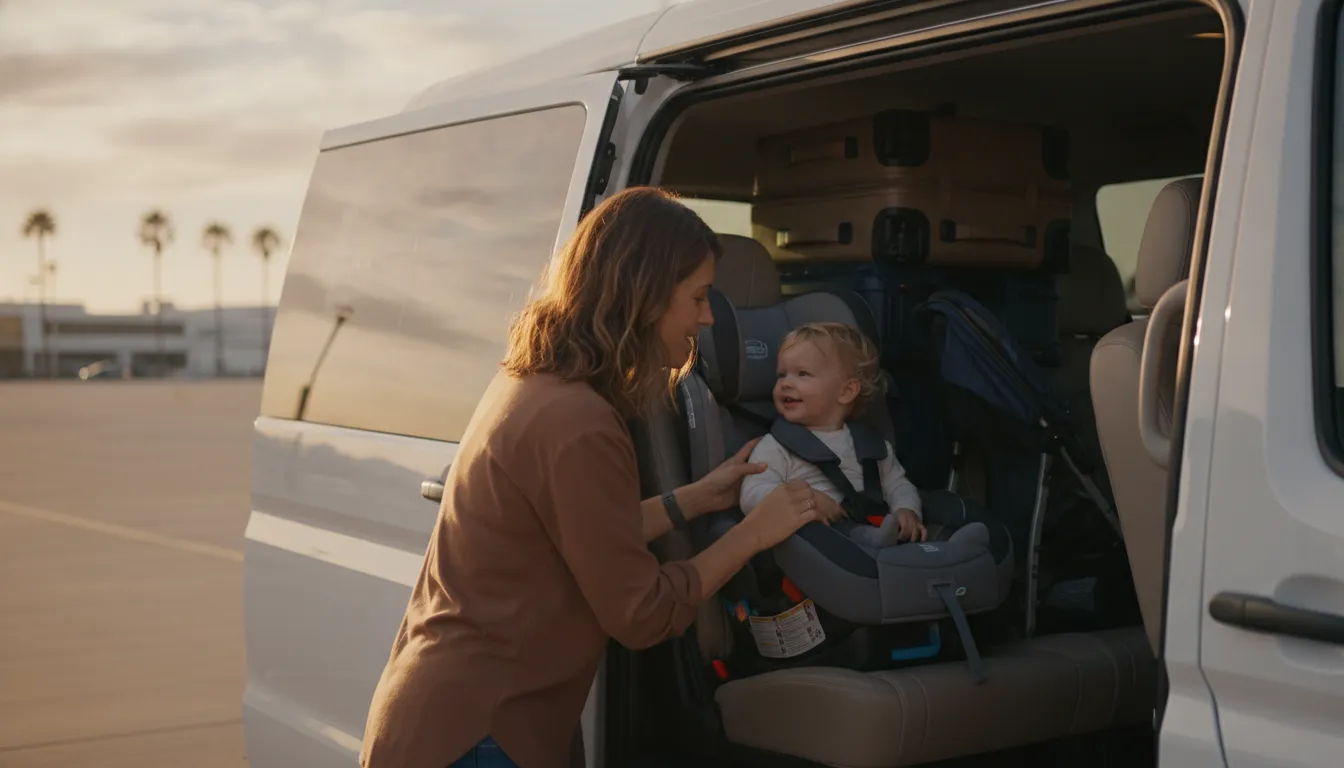
Families looking for an lax airport shuttle with child car seats should treat the restraint request as a booking detail, not a last-minute preference. PickUpRide offers child seats, including infant seats, by advance request. Infant-seat availability is limited, so a family should provide each child’s age and size, the type of seat needed, and the number of seats requested. The reservation team can then confirm what is available rather than leaving the family to guess after landing.
Families may also bring their own car seats at no charge. If you plan to do that, ask during booking about vehicle fit and whether installation assistance is available for your specific seat. Do not assume that a seat can be installed, or that a requested seat is reserved, until those details are confirmed.
Vehicle fit affects the whole arrival
A vehicle that fits the passenger count may still be a poor fit for the luggage. PickUpRide provides private, direct rides in vehicle categories ranging from a five-passenger Express minivan to larger Sprinter options for groups. Luggage capacity varies by vehicle, so include the number of adults, children, bags, and any stroller or bulky equipment when requesting a quote. That information helps the team consider the vehicle and seating arrangement together.
Private service also keeps the family in one vehicle and takes the group directly to its destination. With a shared option, the family may have less control over who travels with them, the pickup sequence, and the time spent reaching the hotel. With rideshare, availability and vehicle details can depend on the request made after landing. PickUpRide is a pre-booked private service, not a shared shuttle, so the focus is on coordinating the ride before the airport day becomes hectic.
For meeting points, communication, and arrival-level details, review this LAX pickup guide for families before your flight.
What California Requires for Child Passenger Restraints
California travel plans should account for both the law and the individual child’s fit in the restraint. This section provides general educational information, not personal legal advice. Laws and official guidance can change, so review the California Department of Public Health child passenger safety page and its links to the official legislative text before your trip. If your circumstances are unusual, consult a qualified professional.
Start with the child’s size and the seat’s limits
The CDC recommends buckling every child in a car seat, booster seat, or seat belt appropriate for the child’s age and size. The seat manual is the practical reference for height and weight limits, installation, and proper use. Age can help describe a general stage, but it should not be treated as a universal cutoff because children grow differently and restraint limits vary.
For infants and young toddlers, the CDC recommends a rear-facing seat with a harness from birth until the child reaches that seat’s maximum height or weight limit. Keep the child rear-facing as long as possible within those limits. A rear-facing seat should not be placed in the front seat, where a passenger air bag can injure or kill a young child.
Move through harness, tether, and booster stages
After a child outgrows the rear-facing seat, CDC guidance recommends a forward-facing seat with a harness and top tether in the back seat. The child should remain in that configuration until reaching the forward-facing seat’s maximum height or weight limit. A top tether is part of the recommended setup. Families should check the vehicle and seat instructions rather than assume every installation is identical.
Once a child outgrows the forward-facing seat, the next stage is generally a booster in the back seat until the vehicle belt fits properly without one. A good fit means the lap belt lies across the upper thighs, not the stomach. The shoulder belt should cross the center of the shoulder and chest, not the neck, face, or edge of the shoulder. The CDC notes that proper belt fit usually occurs between ages nine and twelve, but that range is not a substitute for checking the actual fit.
Check California’s current requirements
The California CDPH page identifies Vehicle Code section 27360 for child restraint requirements, section 27360.5 for safety-belt requirements. Section 27360.6 for penalties and fines, section 27363 for certain medical-condition or size exemptions, and section 27315 for the mandatory seat-belt law. Read the current statutory language directly, especially when traveling with multiple children or when a child has a medical or size-related consideration.
For trip planning, provide each child’s age, height, weight, and requested restraint type when arranging an lax airport shuttle with child car seats. That information helps the transportation provider review the request. But it does not replace the seat manufacturer’s instructions or your responsibility to confirm that the restraint is appropriate and correctly used.
How an LAX Airport Shuttle With Child Car Seats Works
Arranging a child seat starts when you request the ride, not when you arrive at the terminal. PickUpRide provides a pre-booked, private, direct transfer from LAX to your destination, so your family can discuss the vehicle, luggage, and restraint needs before travel day. The service is not a shared shuttle, and the final seat arrangement depends on advance request and confirmation.
Request the seat option when you book
PickUpRide’s documented child-seat add-on is $20 per seat. Infant seats are also listed at $20 per seat, but infant-seat availability is limited, so they require an advance request. Include the number of children, their ages and sizes, and the type and quantity of seats you need when you request a quote or reserve your ride.
Families may also bring their own car seats at no charge. If you plan to do that, tell PickUpRide in advance and ask what installation support and vehicle fit options are available. Professional installation may be available, but do not assume a customer-provided seat will be installed until that detail is confirmed as part of the booking. The safest plan is to discuss the seat model, installation expectations, and who will be responsible for checking the final fit before you travel.
Coordinate a private, direct LAX pickup
Once the reservation details are confirmed, share your flight information, destination, passenger count, and luggage count. Those details help the team coordinate a vehicle that fits the group and its bags. Vehicle capacity and luggage space vary, so a family traveling to Disneyland, Anaheim. Or another Southern California destination should provide complete information rather than estimating at the last minute. For broader planning, see PickUpRide’s guide to group travel from LAX.
For standard curbside pickup, the documented process is straightforward: text after landing, collect your luggage, go to the lower arrival level, and text again when you are outside. Send the assigned pillar number so the driver can approach. If you need an indoor meet-and-greet, ask about that option separately. Before leaving home, reconfirm the child-seat type, quantity, installation details, pickup instructions, and any changes to your flight or group. That confirmation matters because requesting a seat is not the same as having availability guaranteed.
How to Request and Confirm the Right Seat Before Pickup
The smoothest child-seat booking starts with specific information. A request for “one car seat” may not tell the reservation team whether you need an infant seat. A forward-facing seat, or a booster, or whether the vehicle will hold your family and luggage comfortably. Gather the details below before you submit your request, then wait for confirmation before assuming a particular seat is available.
- Share each passenger’s details. List the total number of adults and children, along with every child’s age, approximate height, and weight when available. These details help the team discuss an appropriate restraint option without relying on age alone. If you are unsure which category fits, say so and ask what information the seat manufacturer requires.
- Name the seat type and quantity. State how many seats you need and the type requested for each child, such as an infant seat, child seat, or booster. Infant seats have limited availability and require an advance request. Families may also bring their own seats at no charge. If you plan to do that, ask in advance about vehicle fit and whether installation assistance can be confirmed for your reservation.
- Describe your vehicle and luggage needs. Include the number of suitcases, strollers, car-seat bags, and other large items, not just the passenger count. PickUpRide uses different vehicle sizes, and luggage capacity varies. A larger group or several child restraints may need a different vehicle than a small family with carry-ons.
- Provide the flight and destination. Include your airline, flight number, arrival date and time, terminal if known, and final destination. Name the hotel, Disneyland-area property, home, or other address clearly. For a Sprinter Corporate Coach, request at least three days ahead. For a standard ride, the company recommends arranging service at least two hours before pickup, though earlier requests are wise when seats are needed.
- Obtain written confirmation. Use the booking form to request a quote or reserve your ride, then verify the vehicle, seat types, quantities, route, and pickup instructions. Do not treat a submitted request or quoted price as proof that every requested seat is available. Ask the team to confirm the child-seat arrangement before travel.
- Follow the LAX communication steps. After landing, text the pickup team, collect your luggage, and go to the lower arrival level. When you are outside, text again and send the assigned pillar number so the driver can approach. Review the LAX pickup guide for families before departure, especially if you are arriving internationally or traveling with tired children.
Keep the confirmation and pickup messages easy to find on travel day. If your passenger count, luggage, flight, or child-seat needs change, update PickUpRide promptly so the arrangement can be reviewed rather than assumed.
Infant, Toddler, or Booster: What Details Should You Share?
The right information starts with the child, not a generic age label. When you request a ride, share each child’s age, height, weight, and relevant developmental details. Those facts help narrow the conversation, but they do not replace the car-seat manual, a caregiver’s judgment, or professional safety advice.
Infants and toddlers need more than an age range
The CDC’s child passenger safety guidance recommends a rear-facing car seat with a harness from birth. Continue using it until the child reaches the seat’s maximum height or weight limit. The CDC also advises keeping children rear-facing as long as possible within those limits. A rear-facing seat should not be placed in the front seat.
For infants and toddlers, the available categories can include a rear-facing-only seat, convertible seat, or all-in-one seat. The American Academy of Pediatrics explains through HealthyChildren.org that seat type depends on age, size, and developmental needs. That is why a booking note such as “one toddler seat” may not provide enough detail to confirm the appropriate option.
Forward-facing seats and boosters have different jobs
Once a child outgrows a rear-facing seat, CDC guidance recommends a forward-facing seat with a harness and top tether in the back seat. The child should remain in that seat until reaching its maximum height or weight limit. A combination seat may be an option for some toddlers or preschoolers, but the specific manual controls the limits and use.
After a child outgrows a forward-facing seat, the CDC recommends a booster in the back seat until the vehicle belt fits properly without one. A proper fit means the lap belt rests across the upper thighs rather than the stomach. The shoulder belt should cross the center of the shoulder and chest, not the neck or face. Belt fit often occurs between ages nine and twelve, but children develop at different rates.
What to include in your request
For every child, provide the exact age, current height and weight, and whether the child is an infant, toddler, preschooler, or school-aged child. If you know the current seat type, manufacturer limits, or any developmental consideration that affects positioning, include that information too. Ask the transportation provider to confirm the exact seat option and availability before pickup. Do not assume that a listed category automatically fits your child.
Before travel, review the vehicle owner’s manual and the car-seat manual. HealthyChildren.org recommends reading both whenever a seat is installed. If you bring your own seat, say so during booking and confirm the installation arrangements in advance. These steps keep the reservation details clear without asking a driver or provider to choose a seat for a child.
Why a Pre-Booked Private Ride Can Be Easier for Families
After a flight, families usually have more to coordinate than simply finding an open vehicle. There may be several children, different restraint needs, car seats, strollers, suitcases, and a destination outside Los Angeles. A pre-booked private ride gives the trip a defined starting point: the reservation can include the children’s ages or sizes. The number and type of requested seats, passenger and luggage counts, flight details, and destination.
PickUpRide provides private, direct transportation from LAX rather than a shared shuttle. Its fleet includes vehicles ranging from a five-passenger Express minivan to a Sprinter Corporate Coach for larger groups, with luggage capacity varying by vehicle. Families can compare vehicle sizes and luggage capacity before requesting a quote. Child-seat availability, especially for infant seats, still needs to be requested and confirmed in advance. Planning does not replace confirmation, but it can make the practical details easier to discuss before travel day.
| Planning area | Pre-booked private ride | Rideshare | Shared shuttle |
|---|---|---|---|
| Reservation control | Trip details can be submitted ahead of time, including children, luggage, flight, and destination. | Vehicle and driver assignment generally happens when the ride is requested. | Route, schedule, and space depend on the shared service’s terms. |
| Child-seat planning | Families can request specific seat types and quantities in advance, then confirm availability. | Families must check the available vehicle and seat options at booking. | Seat options and coordination depend on the operator and booking. |
| Vehicle and luggage coordination | Passenger, child, and bag counts help the provider match the request to a vehicle category. | Available vehicle size may vary when the ride is requested. | Shared space and vehicle arrangements follow the service’s assigned itinerary. |
| LAX pickup process | PickUpRide’s standard pickup is curbside at the terminal arrival level. After landing and baggage collection, travelers text when outside and share the assigned pillar number. | Pickup instructions follow the app and the assigned driver. | Pickup points and timing follow the shared shuttle’s instructions. |
For families traveling to Disneyland or Anaheim, a direct route can also reduce the number of handoffs between the airport and hotel. Review the LAX to Anaheim transportation options, and use the Southern California shuttle planning guide when coordinating a larger family group. The best choice depends on your party size, luggage, requested seats, timing, and confirmed availability.
Frequently Asked Questions
What does California require for children riding in a vehicle?
California has specific child-restraint and seat-belt requirements, and the details can change. Review the current guidance from the California Department of Public Health and use a restraint that fits your child’s age, size, and developmental needs. For safety guidance, the CDC recommends keeping children in the appropriate rear-facing, forward-facing, booster, or seat-belt stage based on the seat’s limits and belt fit.
What types of child seats can I request for an airport transfer?
Families can ask about infant seats, forward-facing toddler seats, and booster seats. The right option depends on your child’s current height, weight, age, and developmental needs, along with the specific seat’s manual and limits. Share those details when you book so the requested type can be reviewed before pickup.
How far in advance should I request a child seat?
Request it when you make the reservation, rather than waiting until arrival day. PickUpRide lists infant seats as limited and requires an advance request. Standard rides are recommended at least two hours ahead, while a Sprinter Corporate Coach requires at least three days. Reconfirm the seat type and availability with your reservation.
Can I request more than one car seat for my children?
Yes, include the number of children, each child’s age or size, and the seat type and quantity needed. Also provide the total passenger and luggage counts, since vehicle space varies. The reservation team can then review the vehicle fit and confirm the requested arrangements.
Can I use my family’s own car seat for a private LAX transfer?
Yes, families may bring their own car seat at no charge. Tell PickUpRide in advance and ask about vehicle space and installation during booking. Do not assume a customer-provided seat will be installed until that capability and the arrangement are confirmed for your reservation.
Ready to Plan Your LAX Family Ride?
Share your children’s ages and sizes, the number and type of seats needed, passenger and luggage counts, flight details, and destination when you request your quote. Confirming those details in advance can make the pickup plan easier to coordinate after landing. To request a quote or reserve a private ride with child-seat details reviewed ahead of time, book through PickUpRide’s reservation page.